Physical Address
304 North Cardinal St.
Dorchester Center, MA 02124
Physical Address
304 North Cardinal St.
Dorchester Center, MA 02124


Kazakhstan faces escalating cybersecurity crises as 15 million citizens' data allegedly leaks amid ambitious AI expansion plans. The second major breach in 18 months exposes systemic vulnerabilities in e-government infrastructure at a critical moment for Central Asia's digital future.

Asian societies demonstrate substantially higher enthusiasm for AI adoption than Western nations, driven by different economic structures, geopolitical narratives, and philosophical traditions. This divergence carries significant implications for technological competition and strategic positioning.

China's establishment of the World Artificial Intelligence Cooperation Organization (WAICO) in July 2025 represents a strategic shift from articulating AI governance principles to building permanent institutions capable of normalizing Beijing's state-centric regulatory model globally. With 29 founding members drawn primarily from Africa, Asia, and the Global South, WAICO threatens to entrench digital authoritarian governance standards in emerging AI technologies.

Prime Minister Anthony Albanese announced Australia's AI governance framework, establishing an Office of AI and national standards while rejecting data center moratoria. The approach prioritizes innovation while protecting creators' intellectual property, but leaves critical gaps in addressing AI-generated harms.

China controls over 50% of global production of refined fluorine compounds critical to semiconductors, aerospace, and nuclear technology. While governments focus on diversifying raw material sources, they overlook the more consequential challenge: replicating China's integrated downstream processing ecosystem.

Kazakhstan's dominant super-apps like Kaspi operate beyond meaningful regulatory oversight, wielding corporate power to block accounts and revoke access to essential services. As biometric data aggregates in centralized platforms, the nation faces a critical gap between technological advancement and consumer protection.

Central Asia's rapid digitalisation has outpaced public digital literacy, creating an environment where cybercriminals exploit unprepared populations and weak institutional defences. Addressing this gap requires sustained investment in critical thinking education, institutional cybersecurity governance, and regional coordination.

U.S. export controls on advanced semiconductors are constraining South Korea's technology sector while inadvertently accelerating China's domestic chip development. Seoul faces a strategic dilemma between alliance obligations and economic interests in a rapidly fragmenting global technology supply chain.

China's shift from cloud-based AI to embodied intelligence—physical robots operating autonomously in real-world environments—has significant implications for Indo-Pacific manufacturing, military capability, and regional technological competition. This development could reshape supply chains, accelerate defence modernisation, and deepen technological decoupling across the region.
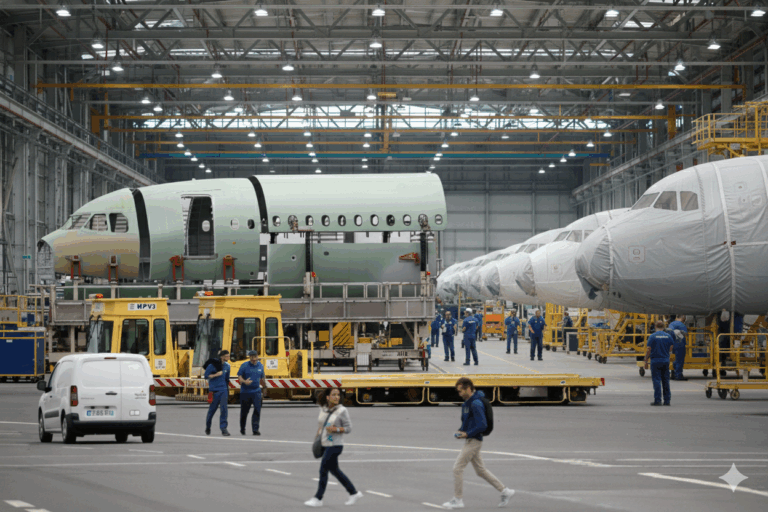
Executive Summary The mandated recall of roughly 6,000 Airbus A320 family jets, stemming from an incident where intense solar radiation potentially corrupted critical flight control data, represents a pivotal moment for global aviation. This crisis, triggered by a seemingly isolated…