Physical Address
304 North Cardinal St.
Dorchester Center, MA 02124
Physical Address
304 North Cardinal St.
Dorchester Center, MA 02124

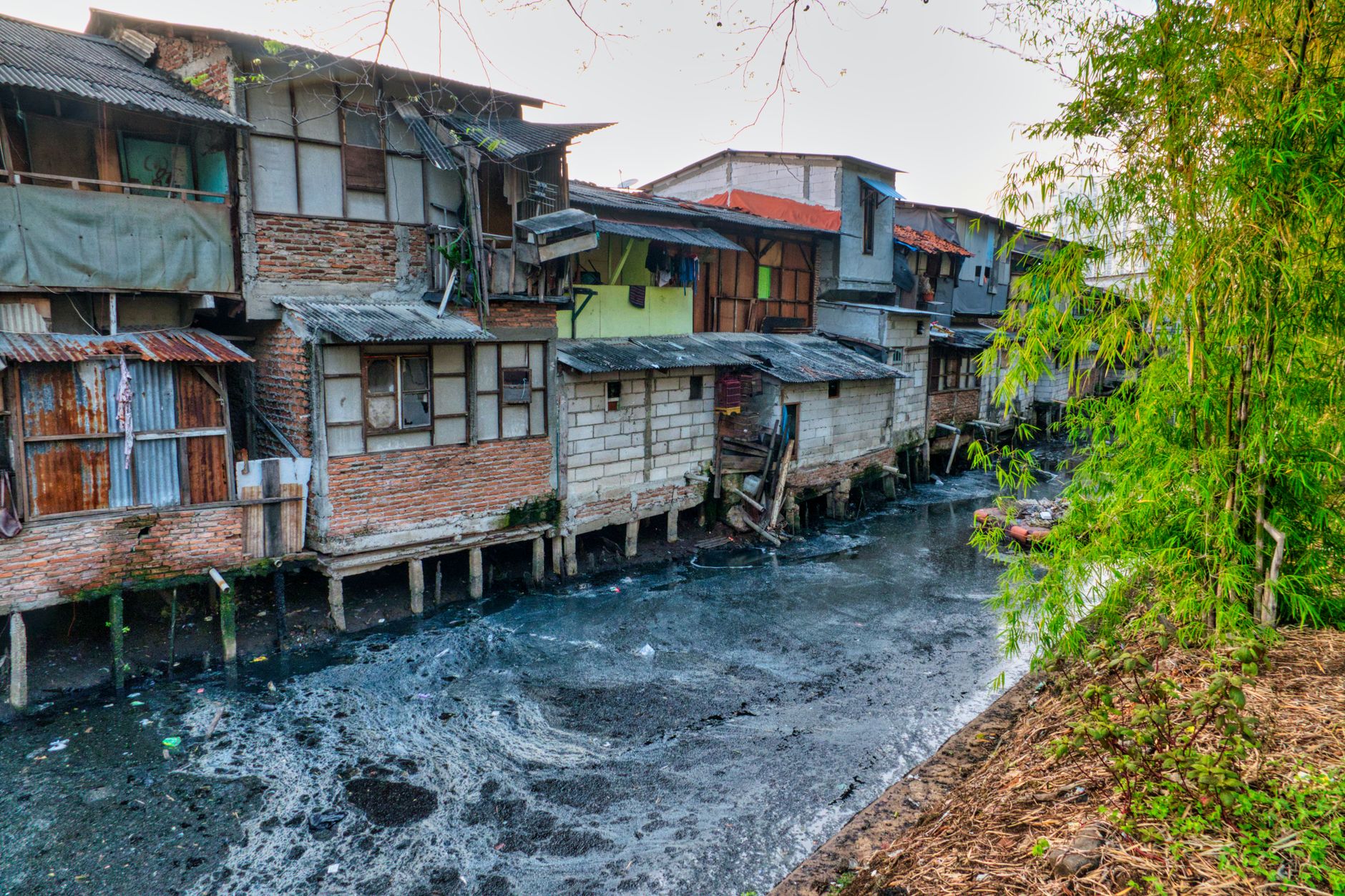
Jakarta's 12 million residents face a critical infrastructure crisis: 18 percent lack piped water access while the city sinks 15 centimeters annually due to groundwater extraction. PAM JAYA's 2029 universal coverage target faces significant feasibility challenges rooted in decades of governance failure.
Jakarta faces a paradox that encapsulates Indonesia’s broader development challenges: a megacity of 12 million residents (42 million in the metropolitan area) where millions lack access to piped water while the city physically sinks beneath them. The capital is subsiding at rates up to 15 centimeters annually in some neighborhoods, with certain areas having dropped four meters since the 1970s. This subsidence is not primarily driven by sea-level rise, but by the very groundwater extraction that residents depend on because piped water infrastructure remains incomplete. The cycle is self-reinforcing and increasingly destructive—and it reveals fundamental failures in Indonesia’s approach to urban water governance over the past three decades.
Jakarta’s water crisis has deep historical roots. The piped water network was originally constructed during the Dutch colonial period to serve European residential enclaves, leaving most indigenous Indonesian communities without connections from the outset. As Wahyu Kusuma Astuti, a lecturer at Universitas Tarumanagara who completed her PhD on Jakarta’s water infrastructure, explains: “The pipe system was limited in the old colonial enclaves. The local communities were not connected from the beginning.”
This colonial-era pattern of unequal access was never corrected as Jakarta expanded into one of the world’s largest cities. Rather than systematically extending piped networks, the city allowed vast peripheral areas to depend on groundwater extraction. By the 1990s, facing pressure to expand services but unwilling to fund massive capital investment directly, the Indonesian government made a fateful decision.
In 1997, under President Suharto, Jakarta’s water system was divided between British utility Thames Water and France’s Suez under 25-year concession agreements. The contracts were awarded through networks closely linked to the Suharto family, with expectations that coverage would reach nearly 98 percent. Instead, researchers argue the arrangement created what Ade Hendraputra, a planner in Indonesia’s Ministry of Planning and Development, terms a “governance void”—no single institution possessed both the authority and incentive to manage the system as an integrated whole. Coverage stagnated while wealthier households, businesses, and government offices abandoned the network entirely, drilling private groundwater wells instead. The privatization model, intended to accelerate expansion, locked Jakarta into decades of underperformance.
The consequences of this fragmented approach have become physically catastrophic. Excessive groundwater pumping—not rising sea levels—is the primary driver of Jakarta’s rapid subsidence. Scientists have documented rates of 15 centimeters annually, with some studies recording even faster rates in localized areas. Neighborhoods in North Jakarta have subsided by up to four meters since the 1970s, creating a landscape increasingly vulnerable to tidal flooding and storm surge.
This subsidence creates a vicious technical cycle: as land sinks, underground pipes crack and shift, allowing treated water to leak before reaching customers. According to PAM JAYA, Jakarta’s public water utility, approximately 50 percent of treated water is lost through leakage. This massive loss reduces the revenue available to repair aging infrastructure and extend networks into underserved communities—precisely the areas most dependent on groundwater wells, which perpetuates the subsidence cycle.
The recognition of this crisis prompted one of Indonesia’s most controversial policy decisions: the decision to build an entirely new capital city, Nusantara, in East Kalimantan. While multiple factors influenced this choice, reducing pressure on Jakarta’s failing infrastructure and sinking geography was a significant consideration.
The incomplete transition to piped water has created stark disparities across Jakarta’s neighborhoods. In Muara Angke, a fishing community on the northern coast, approximately 200 families living in wooden homes above tidal waters have never received municipal piped water. Ellah, who runs a neighborhood water kiosk, purchases 8,000-liter tanker deliveries every few days and distributes water through plastic hoses to around 15 households. For these families, water costs reach 600,000 rupiah ($33) monthly—a substantial burden when average household salaries in the area range from 1.5 to 3 million rupiah ($80-$160) monthly.
Nearby in Penjaringan, 46-year-old grandmother Sadiya relies on groundwater pumped from a mosque for 150,000 rupiah monthly. When the pump fails, she purchases water from vendors at 30,000 rupiah daily ($1.70)—an impossible expense for a household sometimes earning less than 1 million rupiah ($56) monthly. “I feel sad,” she stated. “Sometimes I’m late on the monthly payment because the money has to be divided for everything else.”
The contrast is stark in neighborhoods like Rawabadan Selatan, where families were connected to municipal networks approximately two years ago. Residents previously relied on bore water contaminated by seawater infiltration and pollution—water too dirty for cooking or bathing. As one resident, Walimah, explained: “It is so much better. Previously [the borehole water] made us itchy. We had to rinse again with [cleaner] water.”
These disparities are not accidental. Infrastructure researcher Marwa, completing her PhD on Jakarta’s water governance at Cambridge University, identifies the fundamental problem: “Water infrastructure has never been prioritized, and the responsibility to finance, historically speaking, has always been outsourced to external actors.” The result is that water access has become a marker of inequality, with poor neighborhoods systematically excluded from basic services.
Since returning Jakarta’s water system to full public control in 2023, PAM JAYA has announced its most ambitious expansion in decades. The utility aims to provide piped water to every household by 2029—a six-year timeline. Coverage has already increased from just over 60 percent when PAM JAYA assumed control to approximately 82 percent in 2024, with tens of thousands of new household connections installed over the past year.
This expansion represents a significant strategic shift: recognizing that reducing groundwater dependence is essential not merely for water security but for halting the city’s physical subsidence. Every household connected to the piped network represents one fewer groundwater well, reducing the cumulative extraction driving land sinking.
However, the feasibility of reaching universal coverage by 2029 remains uncertain. The 50 percent leakage rate indicates that existing infrastructure requires substantial rehabilitation alongside expansion. Financing the capital investment needed to extend networks into dense informal settlements like Muara Angke and Penjaringan, where property rights are contested and population density is extreme, presents technical and financial challenges that have defeated previous expansion efforts.
Jakarta’s water crisis represents a failure of governance spanning three decades—from the colonial period’s unequal infrastructure distribution, through the 1997 privatization experiment’s underperformance, to the fragmented service delivery that characterizes the current system. The crisis is not primarily technical; it is fundamentally political and institutional.
The return to public control under PAM JAYA creates an opportunity to treat water as a public service rather than an investment opportunity. However, success requires sustained political commitment and substantial capital investment—resources that have been scarce throughout Jakarta’s modern history. The 2029 target is ambitious; achieving it would require accelerating connection rates beyond current trajectories while simultaneously reducing leakage losses and rehabilitating aging pipes.
The stakes extend beyond water access. Each year of delay in achieving universal piped coverage perpetuates groundwater extraction, accelerating the subsidence that threatens to render parts of Jakarta uninhabitable. The decision to build Nusantara reflects a judgment that Jakarta’s infrastructure challenges are too severe to overcome within the capital’s current geography. Whether PAM JAYA’s expansion succeeds will determine whether that assessment was premature or whether Jakarta’s trajectory toward uninhabitability was already irreversible.