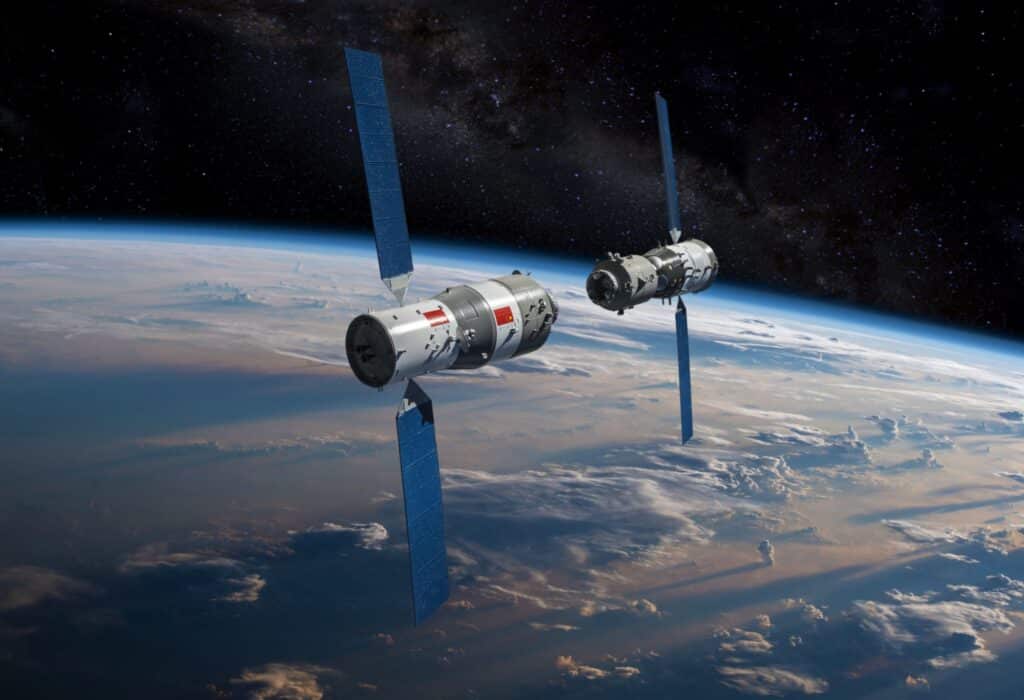
Strategic Resilience and Vulnerability: An In-Depth Analysis of China’s Shenzhou-22 Contingency Launch

EXECUTIVE SUMMARY

The urgent, uncrewed launch of the Shenzhou-22 (SZ-22) spacecraft on November 25, 2025, to replace the damaged return module of Shenzhou-20 at the Tiangong Space Station (CSS), is a pivotal event. This rapid response demonstrates the People’s Republic of China’s (PRC) advanced system redundancy and technical maturity in complex orbital operations.

However, the necessity of the mission—stemming from confirmed or highly suspected Micrometeoroid and Orbital Debris (MMOD) damage—exposes the strategic vulnerability of high-value Low Earth Orbit (LEO) assets. This analysis explores the immediate technical challenges, the economic toll of such contingencies, and the geopolitical implications for China’s long-term space strategy and its role in defining global Space Traffic Management (STM) norms.


I. TECHNICAL LAYER: The Limits of MMOD Protection and Design Evolution

The MMOD impact on the Shenzhou-20 return module necessitates a crucial re-evaluation of China’s spacecraft survivability protocols.

1. The Frailty of Passive Shielding

While Shenzhou capsules employ Whipple shielding or equivalent multi-layer protection, the incident confirms that this passive defense has defined limits.

  • Kinetic Energy Thresholds: Even small fragments, when encountering the spacecraft at speeds exceeding $10 \text{ km/s}$, possess sufficient kinetic energy to breach critical structures. The point of failure appears to be related to either the debris mass/velocity exceeding the design threshold or an impact on a specifically vulnerable area.
  • Safety Precedent: The decision to replace the module instead of conducting an in-depth orbital repair confirms a “safety-first” operational doctrine, where any unverified structural compromise necessitates a full vehicle replacement to guarantee crew return.

2. Anticipated Technical Upgrades

The PRC space program will likely accelerate R&D efforts in three key areas:

  • Reinforced Materials: Implementing next-generation composite or ceramic materials for critical pressure vessel and propulsion system shielding.
  • Active Sensing Capabilities: Deploying more sophisticated in-situ monitoring and diagnostic systems (acoustic or optical) on future Shenzhou iterations to provide immediate, high-fidelity damage assessment without reliance on ground observation.
  • Propulsion System Hardening: Focusing on increased redundancy and physical segregation of fuel lines and thrusters, which are highly susceptible to critical failure from puncture.

II. ECONOMICS AND EFFICIENCY: The High Cost of Redundancy

The Shenzhou-22 launch provides a stark economic indicator of the current “replacement paradigm” in LEO operations.

1. Costly Contingency and Opportunity Loss

  • Financial Drain: The emergency mission requires the immediate use of a Long March 2F rocket and a certified Shenzhou spacecraft, resources that were earmarked for a later, scheduled crew rotation (Shenzhou-23). The resulting costs—including accelerated vehicle preparation, fuel, and launch personnel mobilization—significantly exceed the normal expenditure for a routine mission.
  • Schedule Ripple Effect: The utilization of SZ-22 disrupts the planned crew rotation schedule. This creates immediate pressure on the vehicle production line and could potentially shorten the next crew’s time in orbit or delay the launch of the subsequent expedition.

Key Insight: The necessity to replace rather than repair demonstrates the high operational costs of maintaining strategic LEO assets. This paradigm is unsustainable as China moves toward longer-duration, deep-space missions.

2. The Catalyst for OSAM Development

This incident provides a powerful argument for accelerating the development of In-Orbit Servicing, Assembly, and Manufacturing (OSAM) capabilities.

  • Strategic Shift: China must transition from launching massive, fully redundant modules to deploying smaller, specialized robotic servicing craft capable of patching hull breaches, replacing sensors, or servicing propulsion systems in situ.
  • Deep-Space Necessity: OSAM is essential for future manned missions to the Moon and beyond, where emergency resupply or replacement is infeasible. The SZ-22 incident will likely push this technology from research priority to immediate deployment mandate.

III. GEOPOLITICAL IMPLICATIONS: Orbital Assets as Strategic Vulnerabilities

The damage to the Shenzhou module underscores the strategic fragility of major orbital infrastructure and impacts China’s position in global space governance.

1. Strategic Vulnerability of CSS

Space stations are visible, high-value national assets. The MMOD incident highlights that the CSS, like the International Space Station before it, is continuously operating in a hostile environment, with increasing exposure to fragmentation debris.

  • Deterrence and Monitoring: This incident will undoubtedly increase the PRC’s investment in its own Space Situational Awareness (SSA) capabilities to better track debris and potential threats. It also provides a strategic rationale for enhancing the integration of civilian and military-led orbital monitoring efforts.

2. Shaping Global STM Norms

China will leverage this incident to bolster its influence in international forums regarding Space Traffic Management (STM).

  • Advocacy for Stricter Rules: As a “victim” of orbital debris, China gains diplomatic leverage to advocate for stricter international standards on satellite disposal, particularly directed at the rapid deployment and lifecycle management of non-PRC mega-constellations (e.g., Starlink, Kuiper), arguing that their proliferation increases the MMOD threat for all LEO operators.

CONCLUSION AND OUTLOOK

The successful emergency launch of Shenzhou-22 is a victory of operational resilience for the Chinese space program. It affirms Beijing’s commitment to crew safety and its robust capability to execute complex contingencies.

However, the event serves as a critical inflection point, forcing the PRC to urgently address the economic and technical limitations of its current fleet architecture in the face of rising MMOD threats. The necessity of this mission will accelerate the nation’s transition toward advanced OSAM technologies and influence its calls for a revised, safer framework for global orbital management.

The Shenzhou-22 mission is not merely a replacement; it is a strategic response that will define the next decade of operational safety and technological innovation in Chinese space endeavors.


Disclaimer: This analysis is based on publicly available reports and is intended to provide expert commentary for a professional audience. Views expressed herein do not necessarily reflect the official policy of any government or non-governmental organization.